Free AU Shipping on orders above $120


When I began Wildalaya, I knew I wanted to create clothing that felt good against the skin, breathable, comfortable and easy to move in.
But I also kept asking:
What is this fabric actually made from, and what happens before it reaches us?
A fabric may be described as soft, silky, plant-based or bamboo-derived, but those words do not always reveal how heavily the fibre has been processed, what chemicals were used, or what impact it may have after it is discarded.
Conventional viscose, rayon or polyester are examples of these heavily processed fabrics.
No fabric is completely perfect. We simply want to make more considered choices —ones that better reflect the kind of clothing we want to create and the kind of brand we are building.
Polyester begins as plastic
Polyester is popular because it is inexpensive, durable and easy to produce.
But it is also a synthetic plastic fibre, usually made from fossil-fuel-derived materials.
Polyester clothing can release tiny plastic fibres while it is made, worn and washed. These microfibres can travel through wastewater and remain in the environment long after the garment has left your wardrobe.
Polyester can be useful in technical clothing, protective wear and outdoor equipment. But for the everyday skirts, dresses and shirts we create, we do not believe plastic needs to be the default.
We would rather begin with a fibre grown by the earth.
Viscose and rayon are not as natural as they sound
Viscose and rayon can be confusing because they begin with plant material, usually wood pulp or bamboo.
Rayon is the broader name, while viscose is the most common type of rayon.
Although they start with plants, the material must be dissolved and heavily processed with chemicals before it becomes a soft, flowing fabric.
Conventional viscose production can involve hazardous chemicals and may create air pollution and contaminated wastewater when factories do not manage the process responsibly.
There is also the question of where the wood pulp comes from and whether the forests behind it are being responsibly managed.
So while viscose may begin with a tree, that does not automatically make the finished fabric natural or environmentally gentle.
What about lyocell?
Viscose, rayon and lyocell all begin with plant cellulose, but they are not manufactured in exactly the same way.
Lyocell uses a different process. In well-managed closed-loop systems, much of the solvent and water can be recovered and reused.
We do not believe that every processed fibre is automatically harmful, just as we do not believe that every fabric labelled “natural” is automatically sustainable.
The source, manufacturing process, chemical management and durability of the fabric all matter.
Natural fibres are not perfect either
Cotton, hemp and linen still require land, water, energy, processing, dyeing and transport.
No garment is completely impact-free.
For us, sustainability is not about pretending that a perfect fabric exists. It is about making more thoughtful choices wherever we realistically can.
We prioritise plant-based fibres such as cotton, hemp and linen. We produce in small quantities. We create adjustable silhouettes that can continue fitting as bodies change. And we design pieces to be worn repeatedly, rather than for one short-lived trend.
We are still learning, and we will not always find a perfect answer.
But we can continue asking better questions.
Why it matters to us
Fabric is not simply a detail added after a garment has been designed.
It affects how the clothing feels on your body, how it handles warm weather, how often you wear it and what may be left behind when you are finished with it.
We do not want plastic to become the quiet foundation of every wardrobe simply because it is inexpensive.
We do not want a fibre to be called natural only because it once began as a plant, while ignoring everything that happened afterwards.
And we do not want to pretend that every choice we make is perfect.
We simply want to create clothing with more honesty behind it—pieces that feel comfortable, are made intentionally and can remain part of your wardrobe for years.
That is why conventional viscose, rayon and polyester do not form the foundation of Wildalaya collections.
Because what touches your skin matters and so does the story behind it.
Best Sellers
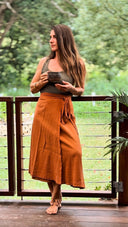

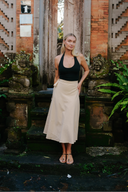
Wildalaya Signature Wrap Skirt
$90.00
Regular price
$100.00
Minimum price
$90.00

Wildalaya Wrap Dress
$87.00
Regular price
$110.00
Minimum price
$87.00


Clay Red Midi Dress
$65.00
Regular price
$99.00
Minimum price
$65.00


Sandy Wrap Top
$60.00
Regular price
$60.00
Why Wildalaya Doesn’t Use Conventional Viscose, Rayon or Polyester